安保理改革に関する総会討論における山﨑大使ステートメント
令和8年10月22日
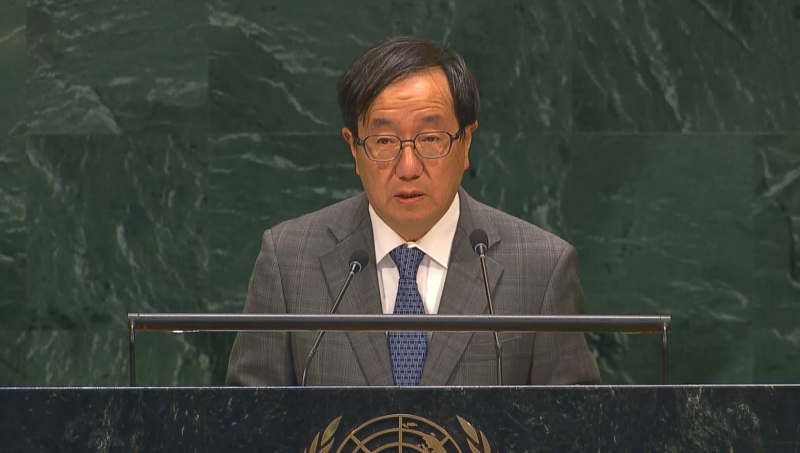
(As delivered)
Thank you, Mr. President,
Japan fully aligns with Germany’s statement on behalf of the G4. I will make additional remarks in my national capacity.
Mr. President,
As has been repeatedly stated, Security Council reform is urgently needed to restore trust in the UN as the center of multilateralism. To make the Council truly representative, legitimate, and effective, it is crucial that the expansion of both permanent and non-permanent categories of membership, which is supported by a majority of the Member States, is reflected in a balanced and equitable manner. A consolidated model should be developed to serve as the starting point for future text-based negotiations.
In this regard, Japan emphasizes that the IGN must be a Member State-led process. While respecting the significant role of the Co-Chairs in initiating such a consolidated model, Japan expresses its strong expectation that this work will be carried out fairly, impartially, and transparently, which is essential for the Member States to fulfill our accountability on the process to our citizens around the globe.
Japan also reiterates the importance of improving the representation of underrepresented and unrepresented regions and groups such as the Asia-Pacific and Latin America and the Caribbean, as stated in the Pact for the Future. In particular, from an Asia-Pacific perspective, our region remains underrepresented in the Council, with only one-fifth of the seats (one permanent seat and two non-permanent seats), even though our region has 54 Member States in the UN and contains more than half of the world's population. At present, 53 countries in the Asia-Pacific Group must compete for just two seats in order to become a non-permanent Council member, which is the most competitive ratio of all the regional groups.
Mr. President,
It is unfortunate that I am compelled to reply in response to the statement by North Korea.
Reflecting upon the past eight decades, Japan has consistently walked the path of a peace-loving nation and has consistently contributed to peace and prosperity in the international community since the end of World War II. This is widely and accurately recognized and highly appreciated by the international community, including this house, the United Nations.
Freedom, democracy, and fundamental human rights remain unshakable foundations of Japan’s every decision and action. Guided by these principles, Japan has made assiduous efforts to promote the rule of law, stressing the importance of compliance with international law, including the UN Charter.
Mr. President,
It has already been two years since the adoption of the Pact for the Future. Japan will continue to play a constructive role in advancing the reform process and delivering tangible results, while actively cooperating with the wider UN membership to move toward our shared goal.
I thank you.
In response to the statement made by the North Korean delegation at the meeting, Mr. Yasuhiro Nakai, Counsellor, delivered the following statement.
I will not repeat what was mentioned in our statement earlier.
Japan has regarded the fact of history with humility and sincerely addressed various issues for over 80 years since the end of World War II. Having served as a non-permanent member of the UN Security Council 12 times over the last 70 years since joining the UN, as well as having been as one of the most important financial contributors, Japan has actively contributed to international peace and security.
Japan will continue such contributions as a responsible member state of the United Nations.