
紛争下の性的暴力に関する安保理公開討論における山﨑大使ステートメント
令和8年7月8日
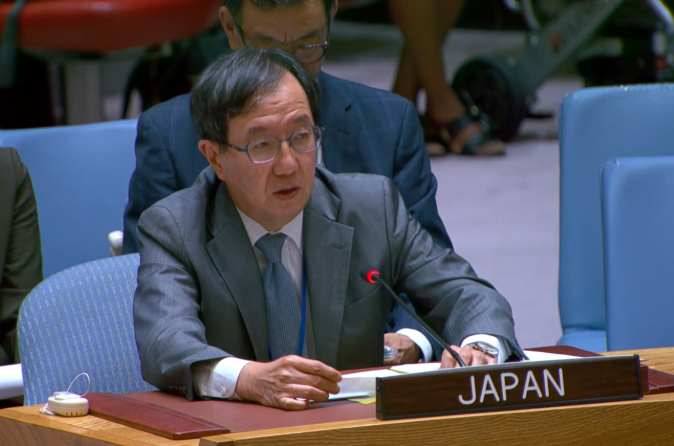
(As delivered)
Thank you, Mr. President.
I thank the Democratic Republic of the Congo for convening this important open debate. I also thank SRSG Patten for your sobering briefing.
Survivors' access to justice for Conflict-related Sexual Violence (CRSV) is severely limited when judicial systems are not fully established, particularly in situations where public infrastructure itself is fragile due to conflict or political instability.
Such conditions make it exceedingly difficult to implement the survivor-centered approach mandated by Security Council Resolution 2467.
To break the cycle of impunity, respect for the rule of law and accountability for perpetrators are indispensable. Japan strongly prioritizes capacity-building for legal professionals and the strengthening of justice-related organizations, which requires coordinated efforts by Member States and the UN system.
Mr. President,
Human rights monitors and humanitarian personnel continue to bravely work on the front lines, including in conflict zones, to realize a survivor-centered approach. Ensuring their physical and psychological safety is also essential for the prevention and elimination of and response to CRSV. Japan calls upon all parties to allow and facilitate full, rapid, safe, unimpeded, and sustained humanitarian access, and to ensure the protection of humanitarian personnel in accordance with relevant international humanitarian law (IHL).
Japan also recognizes the critical role played by Women's Protection Advisers, deployed under UN peace operation mandates, in the prevention of and response to CRSV. Japan underscores the need for full, equal, meaningful and safe participation of women in peacebuilding, aiming at inclusion of CRSV survivors.
Japan has launched a project in the Democratic Republic of the Congo to strengthen survivors' access to justice for CRSV in collaboration with the office of SRSG Patten. Through this project, Japan is working to enhance accountability mechanisms by promoting the registration of CRSV cases with judicial authorities in conflict-affected areas, and by providing technical and logistical support for investigations and prosecutions of cross-border cases.
The survivor-centered approach goes beyond survivors' access to justice. Japan has implemented comprehensive CRSV response tailored to survivors' needs in Mali, Sudan and Central African Republic, addressing medical and psychosocial support as well as social and economic reintegration.
Ensuring survivors' access to justice during and after conflict contributes to restoring and affirming their dignity. This is encapsulated in the "Human Security" approach that Japan has long advocated—preserving human dignity through "protection" and "empowerment".
Mr. President,
Japan remains committed to the WPS agenda and to combating impunity, standing with survivors of CRSV and communities affected by violent conflict, and reaffirms its strong support for the leadership of SRSG Patten and her office.
I thank you.