
女性・平和・安全保障に関する安保理公開討論における山﨑大使ステートメント
令和8年6月17日
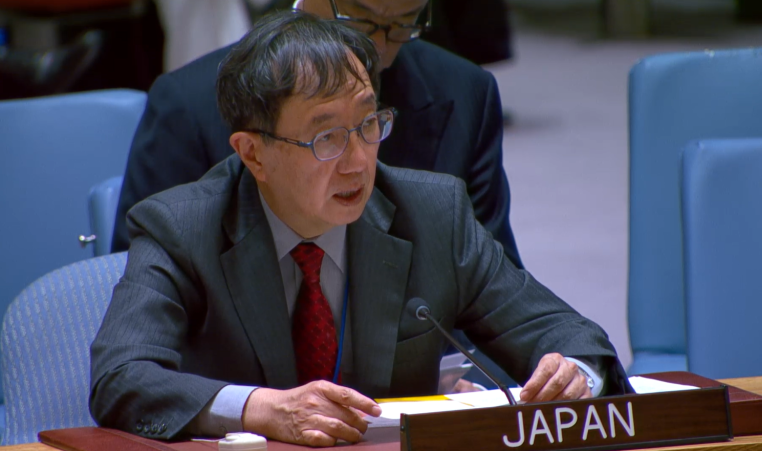
(As delivered)
Thank you, Mr. President,
Japan expresses its sincere appreciation to Colombia for its outstanding leadership on Women, Peace and Security.
Last year marked the 25th anniversary of WPS. Yet despite this milestone, women remain significantly underrepresented in peace negotiations and transitional processes in conflict-affected areas.
In conflict situations, it is critically important that women participate in peace negotiations and political transition processes.
In order to ensure women's full, equal, meaningful and safe participation, it is necessary to create an enabling environment for women to do so. Women are often disproportionately affected by fragile situations, such as water and food insecurity and the breakdown of basic services, particularly in conflict-affected areas with the only reason of their gender. While protection must be prioritized, it is also crucial to create a cycle in which women are empowered, enabling them to more readily engage in subsequent peacebuilding and peace negotiations.
In practice, through its support to UN Women in the Central African Republic, Japan has implemented workshops for approximately 50 women-led civil society organizations to strengthen women's leadership in peacebuilding. Such efforts contribute to building the capacity of women to actively and independently engage in peacebuilding and peace negotiations.
These initiatives are also closely aligned with the approach of Human Security, which Japan has long advocated. This approach places the protection and empowerment of individuals at its core and is consistent with the principle of "leaving no one behind." This human-centered approach can effectively promote women's full, equal, meaningful and safe participation.
With recognizing women-led civil society organizations as indispensable central actors in promoting and sustaining peace, Japan believes that nurturing the next generation of young people is also essential to advancing the WPS agenda. Japan launched the Next Generation Networking Program for Gender Equality in 2025. This program aims to promote gender equality together with the partners across the world, and to realize a future society that is diverse, inclusive, and resilient, embodying Japan's commitment to placing especially women and young people at the heart of peacebuilding.
The Program’s key pillars are the cultivation of next-generation leaders, the creation of interactive platforms for dialogue, and the building of transnational networks, thereby laying the foundation for women-led civil society organizations to exert collective influence on peace processes. Japan remains firmly committed to advancing this agenda together with its partners across the world.
Finally, I would like to mention our practice and contribution. Japan co-chaired the WPS Focal Points Network(FPN)with Norway last year, and we are pleased to welcome Italy and the Philippines as the new co-chairs this year. In the Asia-Pacific region, Japan is committed to lead for promoting the dissemination and implementation of the WPS agenda. Through UN Women, Japan is implementing the "Partnership for Peace" initiative commemorating the 25th anniversary of the WPS agenda, providing support to the Asia-Pacific region. Through this project, Japan is supporting Bangladesh, Pakistan, and Mongolia in developing their WPS national action plans, while promoting more inclusive national networks of women peacebuilders comprised of not only the public sector but also civil society organizations.
Japan remains deeply committed to ensuring women's active participation and leadership in all areas of peace and security and will continue to advance the WPS agenda together with its partners across Asia and beyond.
I thank you.
Japan expresses its sincere appreciation to Colombia for its outstanding leadership on Women, Peace and Security.
Last year marked the 25th anniversary of WPS. Yet despite this milestone, women remain significantly underrepresented in peace negotiations and transitional processes in conflict-affected areas.
In conflict situations, it is critically important that women participate in peace negotiations and political transition processes.
In order to ensure women's full, equal, meaningful and safe participation, it is necessary to create an enabling environment for women to do so. Women are often disproportionately affected by fragile situations, such as water and food insecurity and the breakdown of basic services, particularly in conflict-affected areas with the only reason of their gender. While protection must be prioritized, it is also crucial to create a cycle in which women are empowered, enabling them to more readily engage in subsequent peacebuilding and peace negotiations.
In practice, through its support to UN Women in the Central African Republic, Japan has implemented workshops for approximately 50 women-led civil society organizations to strengthen women's leadership in peacebuilding. Such efforts contribute to building the capacity of women to actively and independently engage in peacebuilding and peace negotiations.
These initiatives are also closely aligned with the approach of Human Security, which Japan has long advocated. This approach places the protection and empowerment of individuals at its core and is consistent with the principle of "leaving no one behind." This human-centered approach can effectively promote women's full, equal, meaningful and safe participation.
With recognizing women-led civil society organizations as indispensable central actors in promoting and sustaining peace, Japan believes that nurturing the next generation of young people is also essential to advancing the WPS agenda. Japan launched the Next Generation Networking Program for Gender Equality in 2025. This program aims to promote gender equality together with the partners across the world, and to realize a future society that is diverse, inclusive, and resilient, embodying Japan's commitment to placing especially women and young people at the heart of peacebuilding.
The Program’s key pillars are the cultivation of next-generation leaders, the creation of interactive platforms for dialogue, and the building of transnational networks, thereby laying the foundation for women-led civil society organizations to exert collective influence on peace processes. Japan remains firmly committed to advancing this agenda together with its partners across the world.
Finally, I would like to mention our practice and contribution. Japan co-chaired the WPS Focal Points Network(FPN)with Norway last year, and we are pleased to welcome Italy and the Philippines as the new co-chairs this year. In the Asia-Pacific region, Japan is committed to lead for promoting the dissemination and implementation of the WPS agenda. Through UN Women, Japan is implementing the "Partnership for Peace" initiative commemorating the 25th anniversary of the WPS agenda, providing support to the Asia-Pacific region. Through this project, Japan is supporting Bangladesh, Pakistan, and Mongolia in developing their WPS national action plans, while promoting more inclusive national networks of women peacebuilders comprised of not only the public sector but also civil society organizations.
Japan remains deeply committed to ensuring women's active participation and leadership in all areas of peace and security and will continue to advance the WPS agenda together with its partners across Asia and beyond.
I thank you.