
安保理改革に関する政府間交渉(IGN)における山﨑大使のステートメント
令和8年1月21日
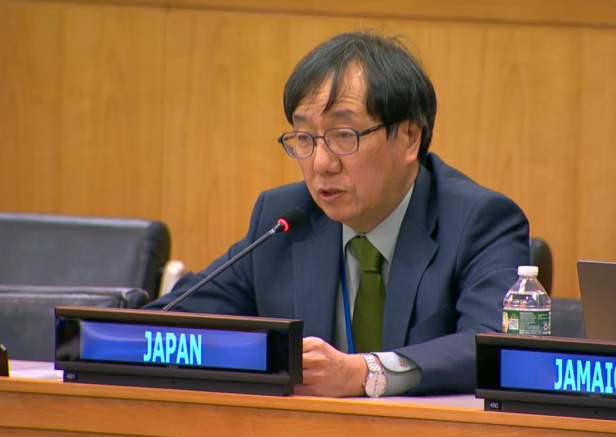
(As delivered)
Thank you, Co-Chairs.
At the outset, Japan welcomes the reappointment of Tareq and the appointment of Lise. Japan's commitment to supporting the IGN Co-Chairs is unwavering.
Japan fully aligns with India’s statement on behalf of the G4. I will make additional remarks in my national capacity under the suggested topic of “Latin America and Asia-Pacific representation on the Council, as well as on cross-regional representation”.
To properly reflect today’s geopolitical realities and effectively address the growing challenges facing the international community, it is crucial to improve the representation of underrepresented and unrepresented regions and groups such as the Asia-Pacific and Latin America and the Caribbean, as stated in the Pact for the Future.
In particular, from an Asia-Pacific perspective, our region remains underrepresented in the Security Council, with only one-fifth of the seats (only one permanent seat and two non-permanent seats), even though our region has 54 Member States in the UN and contains more than half of the world's population. It should be highlighted that 53 countries in the Asia-Pacific Group must compete for just two seats in order to become a non-permanent Council member, which is the most competitive ratio of all the regional groups.
Japan also reiterates the importance of redressing the historical injustice against Africa and expresses once again its strong support for the Common African Position (CAP).
Co-Chairs,
Regarding cross-regional representation, Japan believes that Member States should give due consideration to ensuring better representation for small and medium size Member States, including SIDS.
At the same time, issues such as the definition or appropriate scope and membership of each cross-regional group, and how to deal with the overlap between regional and cross-regional groups, require further discussion. We are more than willing to engage on these matters.
This IGN session is a particularly important milestone, as it commemorates the 80th anniversary of the founding of the UN. It is in the interest of all those who support reform to move to concrete discussions on a consolidated model and to start text-based negotiations. Japan reiterates its commitment to continue to contribute constructively to this end.
I thank you.
In response to statements made by the Chinese and North Korean delegations at the meeting, Mr. Yasuhiro Nakai, Counsellor, delivered the following statement.
It is regrettable that some delegations made groundless statements against Japan.
Since the end of World War II, Japan has consistently followed the path of a peace-loving nation and made innumerable contribution to the peace and prosperity of the international community.
Having served as a non-permanent member of the UN Security Council for the 12th time until the end of 2024, Japan will continue such contributions as a responsible member state of the United Nations.
Japan's position on China’s erroneous statement against our Prime Minister’s remarks is already stated in our PR’s letters to the SG dated November 24th and December 4th last year in response to the Chinese PR’s letters.
Regarding the comments made by the delegation of North Korea, Japan’s intention remains to seek to normalize its relationship with North Korea, in accordance with the Japan-DPRK Pyongyang declaration, through comprehensively resolving the outstanding issues of concern, such as the abductions, nuclear and missile issues, as well as settlement of our unfortunate past.
With regard to the statement made by the Chinese delegation, which is unsubstantiated claims regarding Japan’s position on history, I will refrain from refuting each one individually. The current administration has upheld in its entirety the positions of the previous Cabinets on history and will continue to do so.
To conclude, Japan believes that differences of views should be addressed through dialogue, for that is at the core of the spirit of the UN Charter.