
第64回社会開発委員会における梅津大使ステートメント
令和8年2月3日
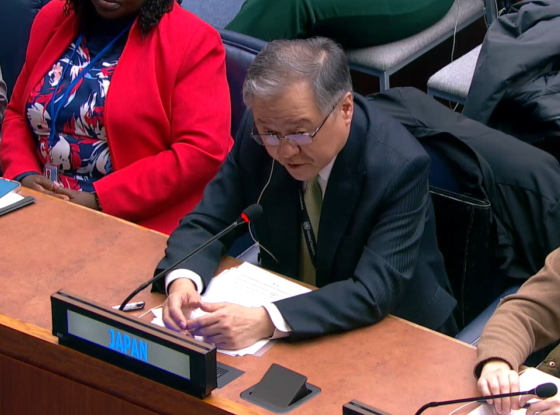
(As delivered)
Thank you, Madam Chair. At the outset, I would like to express our sincere appreciation to you, Madam Chair, and the bureau members, and the secretariat for organizing this session.
Around thirty years ago, the Copenhagen Declaration and Programme of Action were adopted at the World Summit for Social Development. These important documents pledged to place people at the centre of development by ensuring full participation by all, and affirmed the determination of the international community to take action toward “poverty eradication”, “full and productive employment,” and “social inclusion”.
At the Second World Summit for Social Development last year, member states adopted the Doha Political Declaration, renewing our commitment to these three core themes of the Copenhagen Declaration and the implementation of the 2030 Agenda for Sustainable Development. The Summit also reaffirmed that social development is based on human dignity.
Japan appreciates the initiative of Qatar, as the host country, and the leadership of Belgium and Morocco as co-facilitators to compile the Doha Declaration, and welcomes its adoption.
However, due to urgent and complex challenges facing the international community, including social inequality, conflict, and climate change, the progress in social development remains slow and unequal, even when the deadline for the 2030 agenda is pressing.
In this context, Japan believes that this year’s Commission for Social Development held under the priority theme of “advancing social development and social justice through coordinated, equitable, and inclusive policies” is the key to accelerating our commitment to these two political declarations and the SDGs.
To realize a world where no one is left behind, Japan underscores the concept of “human security” which places the individual at the center and seeks to protect human dignity. “Human security” should be a guiding principle to achieve social development, the SDGs and a society where the dignity of every individual is respected.
Madam Chair,
Japan has addressed social challenges such as a declining birthrate, an aging population, natural disasters, and regional revitalization efforts. Based on the experiences and insights gained from these challenges, Japan continues to commit itself to further helping developing countries address their own social challenges in line with the Doha Declaration.
For example, Japan has diligently implemented initiatives in line with the Sendai Framework for Disaster Risk Reduction, and rigorously invested in fostering human development through education. Last August, Japan co-hosted the 9th Tokyo International Conference on African Development, TICAD9, with the AUC, UN, UNDP and World Bank, and adopted the Yokohama Declaration reaffirming our cooperation based on “human security” to co-create innovative solutions with Africa for inclusive growth and sustainable development.
Madam Chair,
Following the Second Social Summit, Japan renews its commitment to advance social development based on “human security” and “human dignity”, adhering to the key principle of the SDGs, “leaving no one behind,” and working hand in hand with like-minded partners.
I thank you.