第80回国連総会本会議「海洋及び海洋法」(議題75)における中井参事官(法律顧問)ステートメント
令和7年12月8日
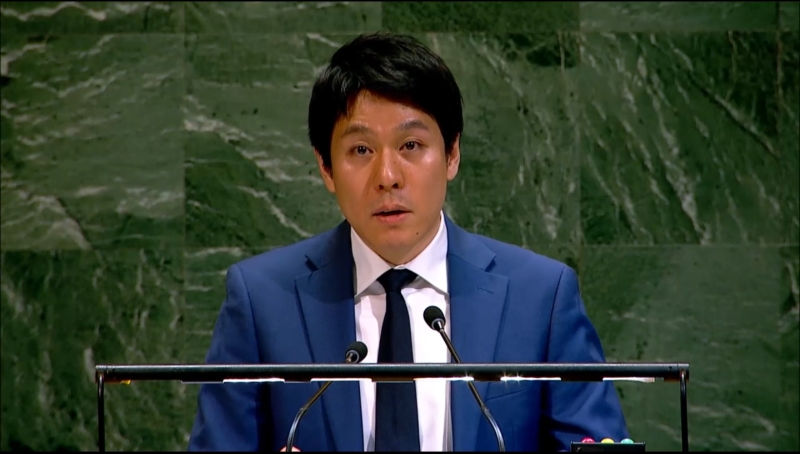
(As delivered)
Mr. President,
First and foremost, Japan would like to extend our gratitude to Ms. Natalie Morris Sharma of Singapore for her remarkable work as a coordinator. Our appreciation also extends to our fellow Member States for their contributions and cooperation, and to the Division for Ocean Affairs and the Law of the Sea (DOALOS) for its commendable support.
Building on its longstanding support, Japan is once again proud to co-sponsor this important draft resolution, “Oceans and the Law of the Sea.” Indeed, at the very core of Japan’s foreign policy pillar, a “Free and Open Indo-Pacific” (FOIP), which has resonated strongly with the international community, lies the principle of the rule of law. This principle underpins our unwavering belief in the universal and unified character of the United Nations Convention on the Law of the Sea (UNCLOS), which governs all activities in the oceans and seas. This encompasses, crucially, the freedom of the high seas, including freedoms of navigation and overflight at its core, the principle of common heritage of mankind governing the Area and activities therein, and the protection and preservation of the marine environment, as well as the peaceful settlement of disputes.
Amidst growing challenges to the maritime order based on the rule of law, we reiterate that all maritime claims must be made in accordance with UNCLOS, which is the basis for determining legitimate rights and interests of States over maritime zones. It is unacceptable to make legal assertions as if there were general international law that overrides matters covered under UNCLOS.
In this respect, Japan has long been advocating “Three Principles of the Rule of Law at Sea”, namely:
- States should make and clarify their claims based on international law.
- States should not use force or coercion in trying to drive their claims.
- States should seek to settle disputes by peaceful means.
Mr. President,
In the evolving landscape of the law of the sea, two particularly noteworthy developments have recently emerged, highlighting progress in addressing contemporary challenges. Significant strides have been made in the context of the legal implications of climate change-related sea-level rise for baselines and maritime zones.
This is crucial for maintaining legal stability and predictability, paramount for States confronting sea-level rise impacts. Japan has repeatedly stated its position that it is permissible to preserve the existing baselines and maritime zones established in accordance with UNCLOS, notwithstanding the regression of coastlines caused by climate change.
From this perspective, we welcome that the Final Report of the International Law Commission (ILC)’s Study Group on sea-level rise in relation to international law affirmed that States are under no obligation to update baselines or the outer limits of maritime zones established under UNCLOS, to account for changes as a result of climate change-related sea-level rise. We further welcome the International Court of Justice (ICJ)'s recognition of this point in its recent Advisory Opinion.
Japan recognizes the crucial importance of the continuity of statehood for protecting affected populations, particularly in terms of legal stability, security, and predictability. Given this issue's direct implications for global peace and security, international cooperation is essential to preserve the territory and territorial integrity of States, and to safeguard the people of those States impacted by sea-level rise. Concurrently, further discussions in relevant forums must carefully consider the legal basis and specific contents of States' obligations and responsibilities concerning sea-level rise.
Mr. President,
It is also worth noting that the Agreement under UNCLOS on the Conservation and Sustainable Use of Marine Biological Diversity of Areas beyond National Jurisdiction (the BBNJ Agreement) has reached the requisite threshold of ratifications for entry into force. Japan welcomes its upcoming entry into force on 17 January 2026, convinced of its profound benefits for the marine environment. Japan has been proactively participating in negotiations at the Preparatory Commission, including having served as a bureau member until April this year, aiming to foster the development of sound, effective, and cost-efficient mechanisms for the Agreement’s successful implementation. We remain steadfast in our commitment to actively contributing to this end moving forward.
Mr. President,
On this occasion, Japan stresses that the adoption of regulations for the exploitation of mineral resources in the Area is a clear requirement of Part XI of UNCLOS, and therefore is of the highest priority for the International Seabed Authority. While protection of the marine environment is also a clear requirement under the Convention, it is essential to remember that UNCLOS aims to establish an international regime for organizing and controlling activities in the Area for the benefit of humankind as a whole. Without effective rules to govern the exploitation of the resources of the Area, such a regime would not be fully competent.
Japan puts great emphasis on developing exploitation regulations that strike a reasonable balance between the protection and preservation of the marine environment, and the Area's mineral resource exploitation, based on sufficient scientific knowledge. Accordingly, we are committed to accelerating the globally orchestrated work on the draft regulations as a matter of priority.
Mr. President,
Japan will continue to cooperate with fellow Member States that share our common belief in the importance of the rule of law as a universal value, and make persistent efforts, especially to realize a FOIP.
In closing, let me reiterate that this draft resolution “Oceans and the Law of the Sea” is the fruit of persistent work by Member States, and we particularly welcome the successful streamlining achieved this year. We hope this draft resolution will be duly adopted by the General Assembly.
I thank you, Mr. President.