
当代表部主催サイドイベント「Responses by Non-Injured States to Violations of International Law」における御巫大使による挨拶
令和8年10月29日
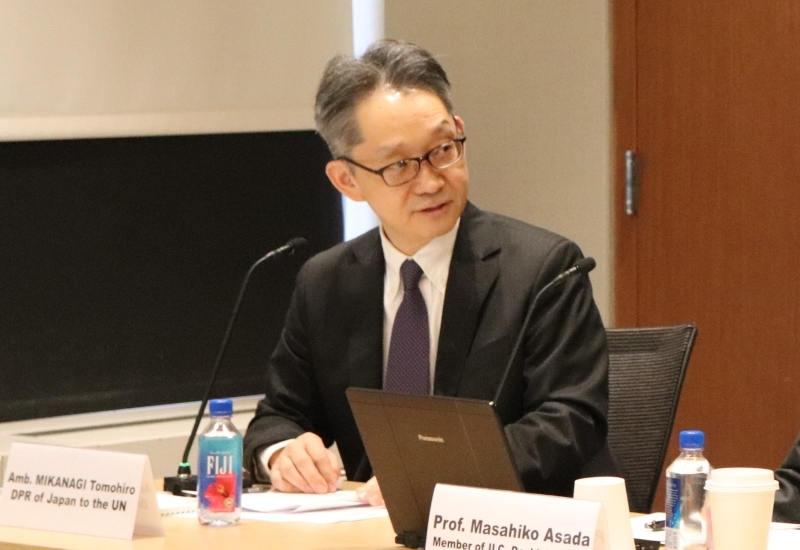
Good morning, everyone. Thank you very much for joining us this morning.
Last year we hosted a side-event celebrating the 55th anniversary of the 1970 Friendly Relations Declaration. The reason for choosing the Friendly Relations Declaration was its historic significance in the pursuit of rule of law in international community.
This year’s topic may look more technical, which is “Response by Non-Injured States to Violations of International Law”. However, this topic is also chosen as a potentially useful angle from which we can examine the current state of rule of law in the international community.
The term “non-injured States” comes from Article 48 of the International Law Commission (ILC)’s Articles on State Responsibility for Internationally Wrongful Acts (2001). This article referred to invocation of responsibility by a State other than an injured State and obligations owed to a group of States and to the international community as a whole, which are also called obligations erga omnes partes and erga omnes respectively.
In March 2026, Oxford Institute for Ethics, Law and Armed Conflict (ELAC) organized a workshop titled “Responses by Non-Injured States to Violations of International Law” in Oxford. The Government of Japan participated in this workshop and learned a lot from it. Today, we invited four prominent scholars who participated in the workshop in Oxford.
Professor Masahiko Asada, Member of the International Law Commission, and Professor of Doshisha University, Japan, Professor Dapo Akande, also Member of the ILC, and Professor of Oxford University, Dr. Priya Urs, Lecturer of University College of London, and Prof. Dr. Chiara Giorgetti, Professor of Law of Richmond Law School.
In the following, first, I will ask Professor Asada, Professor Akande and Dr Urs to make presentation relating to the responses by non-injured States.
Professor Asada will examine the relationship between the two rather confusing concepts relating to non-injured States, which are obligation Erga Omnes and Peremptory Norms. Professor Asada will examine the jurisprudence of ICJ and its relations with the ILC’s discussion.
Professor Akande will talk about the relationship between directly injured States and non-injured States. For example, can non-injured States invoke responsibility separately from response by the injured States?
Dr. Urs will talk about which State are ‘specially affected’ as mentioned in Article 42(b)(i) of the ILC’s Articles on State Responsibility, focusing on the case of aggression.
After these three presentations, I will ask Professor Giorgetti to make comments on their presentations.
Now, I would like to ask Professor Asada to take the floor.