
「気候変動に係る国家の義務に関する国際司法裁判所勧告的意見」に関する国連総会決議採択に際する前田書記官による投票理由説明(EOV)
令和8年6月4日
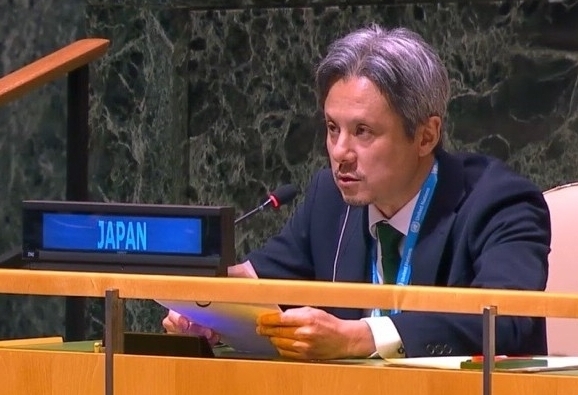
(as delivered)
Thank you, Mr. President.
Japan would like to express its utmost respect to Vanuatu and the core group, for their efforts to address the urgent threat of climate change. Japan reiterates its steadfast commitment to implement global climate actions under the UNFCCC and the Paris Agreement.
The Advisory Opinion of the International Court of Justice (ICJ) serves to clarify the rules and principles of international law and contributes to the strengthening of the rule of law. Japan attaches the highest importance to the work of the ICJ and has actively participated in the proceedings concerning the Court’s Advisory Opinion on climate change. For this reason, Japan voted in favor of this resolution.
It should be stressed that the advisory opinions of the ICJ are not legally binding per se, and thus we emphasize the need to further examine State practice in relation to this Advisory Opinion.
Japan notes with concern that the resolution contains numerous elements that are not in the Court’s opinion and also does not capture some important aspects. At the same time, this resolution does not accurately quote elements from COP decisions. This could potentially undermine the effectiveness of climate actions, which are implemented consensus based.
Mr. President,
Japan would like to express its views on the following points, in particular.
First, on PP8(a)(iv) and OP2(a), in relation to the “CBDR”, we must point out that the resolution does not reflect the views of the Advisory Opinion in its entirety, and it is regrettable.
Specifically, the resolution should include the phrase “in the light of different national circumstances” after the phrase “common but differentiated responsibilities and respective capabilities” to properly reflect paragraph 150 and 226 of the Advisory Opinion. In paragraph 150, the Court, in interpreting the principle of CBDR-RC, expressed its views that since the conclusion of the UNFCCC, some of the developing countries contribute significantly to global GHG emissions and possess the capacity to engage in meaningful mitigation and adaptation efforts, as well as other States with significant resources and technical capabilities to contribute to addressing global climate change. This paragraph clarified that the principle of CBDR-RC does not mean static status of States as developed or developing. In paragraph 226, the Court expressed the view that the added phrase in the Paris Agreement does not change the core of the principle but adds nuance by recognizing that the status of States as developed or developing is not static. This nuance should have been reflected in the resolution.
Second, on OP4. As Vanuatu mentioned in their introductory presentation, this paragraph draws on the agreed language from the first Global Stocktake (GST). However, we regret that this resolution hasted for its adoption without accurately quoting paragraph 28 of the GST. Some words came suddenly from the Rev2 of the draft resolution. Technical alignment with the GST was needed for this paragraph. By way of example, Paragraph 28 of the GST decision calls on Parties to contribute to the global efforts, in a nationally determined manner, including, inter alia, tripling renewable energy capacity globally by 2030 and doubling the global average annual rate of energy efficiency improvements. Although Japan abstained from the package amendment of paragraphs, Japan makes it clear that it will not accept any interpretation that differs from paragraph 28 of the GST Decision.
Third, on OP7 regarding the affirmation of the continuity of statehood in the face of sea-level rise, Japan is in the view that there is neither sufficient State practice nor opinio juris. We remain ready for further inter-state discussions for legal certainty.
Fourth, on OP10, we believe that the Secretary-General’s report should be a compilation of inputs from Member States. Japan expresses its serious concern that it could potentially break the consensus-based climate negotiations under the UNFCCC and the Paris Agreement and the foundation of the existing climate-related legal frameworks, including nationally determined cooperative frameworks, established through long and difficult negotiation.
Lastly, regarding PP3, the right to a clean, healthy and sustainable environment has the potential to be extremely broad in scope and has yet to be clearly defined. The Court said that the right is a precondition for the enjoyment of other human rights but does not recognize the right as human rights established under international law.
In conclusion, Japan expresses its steadfast commitment to the rule of law and to the implementation of global climate actions under the UNFCCC and the Paris Agreement.
I thank you.