
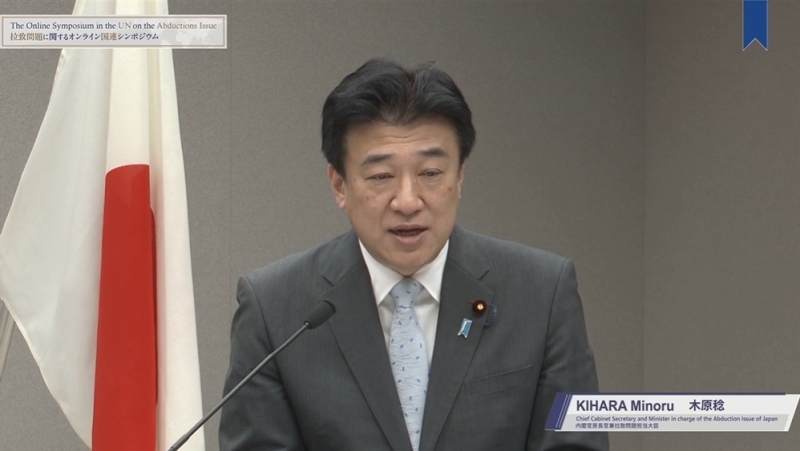
拉致問題に関するオンライン国連シンポジウムにおける木原稔内閣官房長官兼拉致問題担当大臣による基調発言
令和8年6月24日
(provisional translation)
I am KIHARA Minoru, Chief Cabinet Secretary and Minister in charge of the Abduction Issue. On behalf of the Government of Japan, I would like to express my gratitude to the United States, Australia, the Republic of Korea, and the European Union for co-hosting today’s symposium, as well as to the officials of the United Nations for their cooperation. I would also like to extend my appreciation to all participants and viewers.
The issue of abductions by North Korea remains an ongoing issue, as victims continue to be deprived of their freedom and unable to return home to this day. Of the 17 Japanese citizens identified by the Government of Japan as victims of abduction by North Korea, only five have returned to Japan. In addition, there are many other missing people for whom the possibility of abduction cannot be ruled out. As both the victims themselves and their family members are aging, there is no time to lose in resolving the abductions issue.
Furthermore, I would like to reiterate that the abductions issue is not only a matter for Japan but also a common challenge for the international community. Among the Japanese victims, there are young people who were abducted while studying abroad. One such individual is Mr. MATSUKI Kaoru, who was staying in Spain at the time. Mr. Matsuki is from Kumamoto, my home electoral district, and I have worked alongside his family to achieve his return to Japan since before I became a member of the Diet.
Moreover, the report of the U N Commission of Inquiry on human rights in the DPRK refers to victims of abductions from ten countries other than Japan. Today, in addition to remarks by family members of Japanese victims, you will also hear messages from families in the United States and Thailand.
Amid rapidly changing international circumstances, it is more important than ever for all countries to work together to address challenges. The abductions issue is precisely one that the international community should tackle in cooperation. Prime Minister Takaichi has raised the abductions issue in meetings with the leaders of each of the countries co-hosting today as well as at the G7 Evian Summit held last week. Prime Minister Takaichi also concurred with United Nations Secretary-General Guterres, who
The issue of abductions by North Korea remains an ongoing issue, as victims continue to be deprived of their freedom and unable to return home to this day. Of the 17 Japanese citizens identified by the Government of Japan as victims of abduction by North Korea, only five have returned to Japan. In addition, there are many other missing people for whom the possibility of abduction cannot be ruled out. As both the victims themselves and their family members are aging, there is no time to lose in resolving the abductions issue.
Furthermore, I would like to reiterate that the abductions issue is not only a matter for Japan but also a common challenge for the international community. Among the Japanese victims, there are young people who were abducted while studying abroad. One such individual is Mr. MATSUKI Kaoru, who was staying in Spain at the time. Mr. Matsuki is from Kumamoto, my home electoral district, and I have worked alongside his family to achieve his return to Japan since before I became a member of the Diet.
Moreover, the report of the U N Commission of Inquiry on human rights in the DPRK refers to victims of abductions from ten countries other than Japan. Today, in addition to remarks by family members of Japanese victims, you will also hear messages from families in the United States and Thailand.
Amid rapidly changing international circumstances, it is more important than ever for all countries to work together to address challenges. The abductions issue is precisely one that the international community should tackle in cooperation. Prime Minister Takaichi has raised the abductions issue in meetings with the leaders of each of the countries co-hosting today as well as at the G7 Evian Summit held last week. Prime Minister Takaichi also concurred with United Nations Secretary-General Guterres, who
visited Japan last month, to continue to cooperate on policies toward North Korea including on the abductions issue. Successive United Nations High Commissioners for Human Rights have also shown continued interest in addressing this issue, including listening to the voices of the families of the victims. For almost 20 years, the United Nations General Assembly and the Human Rights Council have annually adopted resolutions on the human rights situation in North Korea, which include references to the abductions issue. It is important to continue conveying the united voice of the international community. The Government of Japan has been seeking understanding and cooperation on the abductions issue through every opportunity including bilateral meetings, the United Nations framework, and other international conferences, and has received very encouraging expressions of support. I would like to take this opportunity to once again express my sincere appreciation.
Above all, securing the return of Japanese victims is a matter that Japan itself must address proactively. Prime Minister Takaichi considers the resolution of the abductions issue to be a mission entrusted to her, stating that she is “determined to resolve the abductions issue by making a breakthrough in my tenure, without ruling out any options, including a summit meeting with President Kim Jong Un.” She also expressed her hope that “Japan and North Korea will work steadily toward mutual prosperity as well as regional peace and stability.” Under her strong leadership, the Government of Japan is making every possible effort. I myself have directly heard the earnest feelings of the families and those involved, and I am working with the determination to be the last Minister in charge of the Abduction Issue.
Today, experts will also engage in discussions on what can be done toward “opening a window of opportunity for the immediate resolution of the abductions issue”, amid complex regional and international circumstances. I strongly hope that today’s symposium will serve as an opportunity to deepen the international community’s understanding of the abductions issue and to build further momentum toward its resolution.
In closing, I would like to express my deepest appreciation once again to all those involved. Thank you very much.