
アフガニスタンに関する安保理会合に際した共同プレスステークアウト
令和7年12月10日
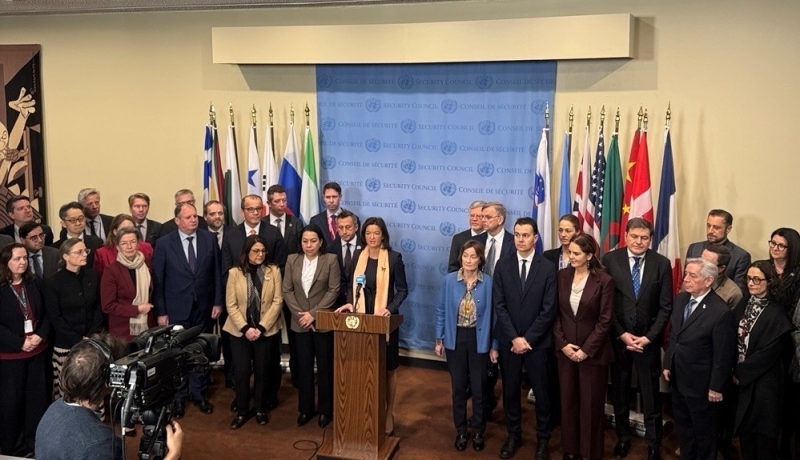
Joint statement delivered by H.E. Ms. Tanja Fajon, Deputy Prime Minister and Minister of Foreign and European Affairs of the Republic of Slovenia, on behalf of 55 UN Member States and the EU Delegation, on the occasion of Human Rights Day
I am honored to deliver this statement on behalf of Afghanistan, Andorra, Armenia, Australia, Austria, Belgium, Bosnia and Herzegovina, Bulgaria, Canada, Costa Rica, Chile, Croatia, Cyprus, Czechia, Denmark, Estonia, EU Delegation, Finland, France, Germany, Greece, Guyana, Hungary, Iceland, Ireland, Italy, Japan, Latvia, Liechtenstein, Lithuania, Luxembourg, Kingdom of the Netherlands, Malta, Moldova, Monaco, Montenegro, Morocco, New Zealand, North Macedonia, Norway, Pakistan, Palestine, Panama, Peru, Poland, Portugal, Republic of Korea, Romania, San Marino, Slovakia, Spain, Sweden, Switzerland, Ukraine, United Kingdom and Slovenia. We represent delegations committed to encouraging discussions of human rights into all deliberations of the Security Council.
Today, as we observe the International Human Rights Day, we recall that the Universal Declaration of Human Rights almost 80 years ago affirmed that every human being is entitled to the full spectrum of inalienable and universal human rights – regardless of race, color, sex, language, religion, political or other opinion, national or social origin, property, birth or other status.
It is undeniable that widespread disregard for and abuse and violations of human rights often cause, exacerbate or prolong conflicts. Serious human rights violations and abuses may be matters of threat to peace and security. Considering human rights as part of Council’s work is therefore important to addressing instability and conflict as well as prevention and peacebuilding in a comprehensive manner.
The UN human rights system offers a collective toolbox for the increased awareness and assessment of the situation on the ground. It can thus provide invaluable support and expertise to the Council, including through briefings by the UN High Commissioner for Human Rights.
We also reaffirm that accountability for gross human rights violations and abuses is essential to ensure justice for victims and survivors and for the healing of societies and for creating favorable conditions for sustainable peace. Alleged human rights violations and abuses must be addressed through credible investigations, prosecutions and holding of all perpetrators to account. Impunity is not just a failure of justice and morality, it is a direct driver of conflicts, instability and insecurity.
Today, the Council will address the situation in Afghanistan – a country with immense human potential on one hand, but also a country where the Taliban’s ongoing discriminatory policies and practices have resulted in one of most dire human rights records globally, marked by deep inequalities and pervasive discrimination.
We condemn the Taliban’s systematic and widespread human rights violations, particularly against women and girls, who continue to face an institutionalized system of segregation, exclusion, and disregard for their dignity. Severe restrictions on their education, employment, freedom of movement and any role in political and public lives are not merely robbing them of their future, and Afghanistan of their contribution to economic and social development. These restrictions on women and girls also represent a profound attack on human rights as well as on the human rights standards that the international community built. An attack on – as the OHCHR puts it in this year’s motto – human rights as our everyday essentials. As we conclude this year’s UN WOMEN campaign of 16 Days of Activism Against Gender Based Violence, we wish to pay tribute to Afghan women’s resilience in the face of continuous discrimination and oppression.
Likewise, the Taliban’s repression of Afghan journalists and civil society, targeting of ethnic and religious minorities, public executions and corporal punishment, arbitrary arrests and other grave abuses continue to be committed with impunity.
These actions not only violate Afghanistan’s international obligations but also undermine the prospects for sustainable peace, stability, and prosperity of the country. We reiterate our call on the Taliban to immediately cease and reverse all their ongoing systematic human rights abuses and violations, in particular all restrictions on women and girls’ rights, and allow independent national and international monitoring and accountability mechanisms to operate without obstruction.
Human rights are not an adjunct to peace and security—they are a prerequisite. The Security Council cannot efficiently address instability without confronting the human rights violations and abuses that so often fuel cycles of violence.