女性・平和・安全保障に関する安保理公開討論に際した女性・平和・安全保障共同コミットメント参加国による共同プレスステークアウト
令和8年6月17日
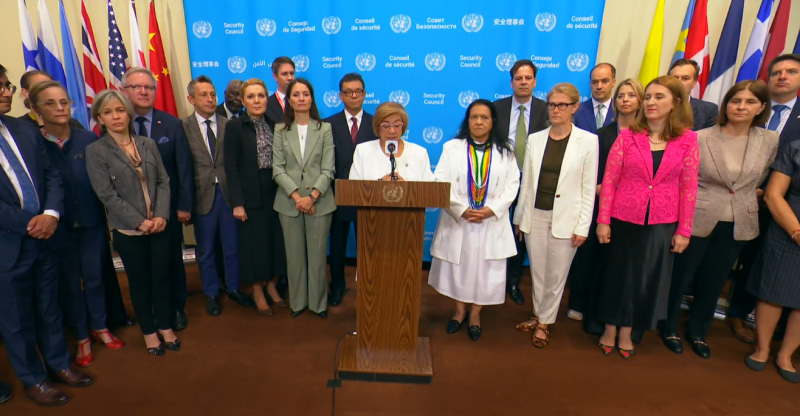
Good morning, excellencies, colleagues:
We, the representatives of Denmark, France, Greece, Latvia, Liberia, Panama, the United Kingdom and my own country, Colombia, signatories of the Shared Commitments on Women, Peace and Security, joined also by Albania, Germany, Australia, Austria, Belgium, Bulgaria, Canada, Czechia, Cyprus, Croatia, Denmark, Slovakia, Slovenia, Spain, Estonia, Finland, France, Greece, Hungary, Ireland, Italy, Japan, Latvia, Lithuania, Luxembourg, Malta, Mexico, Montenegro, Netherlands, Poland, Portugal, Romania, Sweden, Switzerland, Uruguay and the European Union, reaffirm that sustainable political solutions can only be achieved with the full, equal, meaningful and safe participation of women and girls.
We urge all States to fully implement resolution 1325 and the subsequent resolutions of the Security Council on Women, Peace and
Security through concrete and verifiable action: ensuring the full, equal, meaningful and safe participation of women at all phases and levels of peace processes; establishing frameworks for the prevention and accountability of all forms of violence, including sexual and gender-based violence; providing sustained and adequate funding for women’s organizations; protection from reprisals for human rights defenders; and accountability for attacks and threats against them.
We underscore the importance of building on good practices and shared experiences among States, regional organizations, the United Nations, and civil society, including women-led organizations.
Implementing these provisions means defending a vision of peace that duly includes those who have borne its highest costs.
The devastating consequences of conflict are not gender-neutral: they deeply affect women, young women, adolescents and girls in differentiated manners, exposing them to specific risks and distinct forms of violence, exclusion and vulnerability.
Yet women remain underrepresented in the spaces where political, humanitarian and security responses are defined. This gap weakens
We underscore the importance of building on good practices and shared experiences among States, regional organizations, the United Nations, and civil society, including women-led organizations.
Implementing these provisions means defending a vision of peace that duly includes those who have borne its highest costs.
The devastating consequences of conflict are not gender-neutral: they deeply affect women, young women, adolescents and girls in differentiated manners, exposing them to specific risks and distinct forms of violence, exclusion and vulnerability.
Yet women remain underrepresented in the spaces where political, humanitarian and security responses are defined. This gap weakens
the legitimacy of our decisions and limits the effectiveness of our actions.
In a context marked by the surge in armed conflicts and the erosion of consensus, it is increasingly evident that international peace and security must be addressed from a perspective that recognizes gender inequalities and promotes inclusive decision-making.
The Women, Peace and Security agenda requires far more than the reiteration of principles. We call on this Council, Member States and the UN to translate its commitments into concrete action by incorporating this agenda into mandates, budgets, monitoring mechanisms and any other relevant decision.
Peace initiatives will be truly sustainable only when women are regarded as indispensable leaders, negotiators and decision makers, whose equal and inclusive representation is key to lasting peace.
I thank you.