
Statement by Ms. YOSHIDA Aya, Minister, Permanent Mission of Japan to the United Nations, at the 48th Session of the Committee on Information
2026/4/27
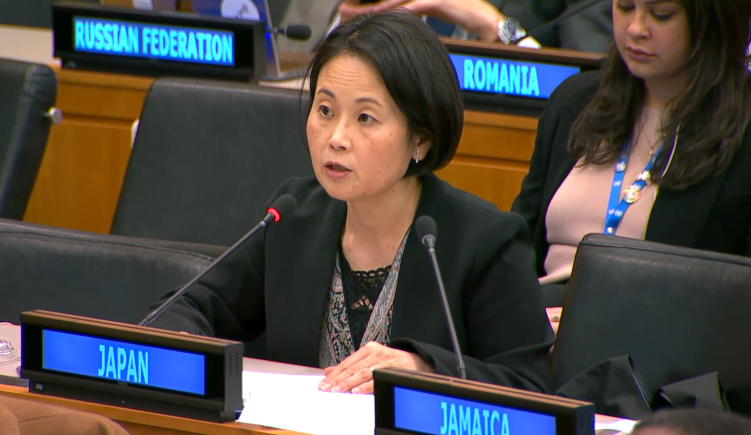
(As delivered)
Thank you, Mr. Chair, for giving me the floor.
At the outset, I would like to extend my gratitude to Ambassador Tammsaar of Estonia, in his capacity as Chair of the 48th session of the Committee on Information for his successful leadership.
Further, I thank USG Melissa Fleming for her insightful briefing today on the continued efforts to reform the DGC.
Mr. Chair,
In this statement, I will briefly touch upon the importance of strengthening public trust in the UN through effective communication, the role of the DGC in this regard, and the value of locally grounded outreach.
It is now more critical than ever for the UN system to engage meaningfully with the peoples of Member States, in order to disseminate accurate, timely, and trustworthy information on its work and on its concrete contributions to addressing global and regional challenges through multilateralism.
In an increasingly fragmented information environment, marked by misinformation, disinformation, and declining trust in multilateral institutions, such engagement is indispensable.
In this context, efforts to uphold information integrity are essential and inseparable from respect for international law, human rights, and freedom of expression. Measures to address misinformation and disinformation should therefore be grounded in transparency, accountability, and cooperation among a wide range of stakeholders, including governments, international organizations, media, civil society, and the private sector, with a strong emphasis on the dissemination of accurate, fact-based information.
Mr. Chair,
Against this background, Japan recognizes that the DGC lies at the heart of advancing these objectives. Japan also views the ongoing reform of the DGC as part of the broader UN80 efforts to strengthen a more effective, transparent and modern UN. We commend the Department’s continued efforts to uphold information integrity, strengthen public trust through fact‑based and transparent communication, and reach diverse audiences in the languages they use and through the channels we trust.
Japan also emphasizes that effective, inclusive, and multilingual communication remains essential to sustaining confidence in the UN and to reinforcing the relevance of multilateral cooperation for people around the world.
In this regard, Japan commends the public information activities of UNIC Tokyo, under the leadership of Director Nemoto Kaoru, which played an important role in conveying the work and priorities of the United Nations to audiences in Japan.
Through outreach conducted in the Japanese language, UNIC Tokyo has enabled a wide range of stakeholders—including the general public, academia, civil society, and the private sector—to access and engage with the work of the UN in a manner that reflects local contexts and interests.
In particular, its outreach and partnerships on issues such as the SDGs and climate action have contributed to fostering broader understanding, encouraging multi‑stakeholder engagement, and promoting a sense of shared responsibility for global challenges at the local level. Such locally grounded communication, across digital platforms, traditional media, and in‑person engagement, remains an effective means of strengthening public awareness of, and trust in the United Nations.
Before concluding, Japan would like to recall the successful participation of the United Nations in the Expo 2025 Osaka, Kansai, Japan, as reflected in the SG’s report on the activities of the DGC. The Expo demonstrated the capacity of the UN, through coordinated and strategic outreach, to engage millions of people and to convey its values and priorities in an accessible and compelling manner.
In this context, the presence of the Peace Bell at the UN Pavilion served as a powerful reminder of the Organization’s enduring commitment to peace and solidarity. Japan continues to attach importance to initiatives that connect the UN’s core values with people around the world through meaningful public engagement.
Finally, Japan remains committed to supporting the reform efforts of the DGC, recognizing that, in an environment where misinformation and disinformation are increasingly prevalent, timely, accurate and fact‑based communication by the UN is essential to strengthening public trust in the Organization.
I thank you.