Statement by H.E. Ambassador YAMAZAKI Kazuyuki, Permanent Representative of Japan to the United Nations, at the United Nations Security Council Briefing on “Non-proliferation/Democratic People's Republic of Korea”
2026/4/30
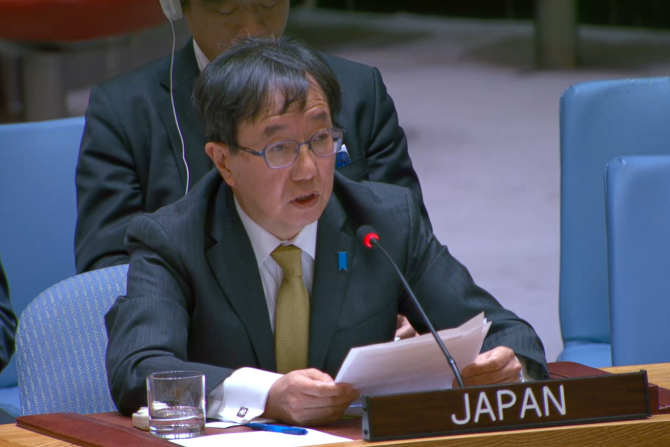
(As delivered)
Thank you, Mr. President, for convening this critical meeting. I also thank USG DiCarlo and Mr. James Byrne, the CEO and Founder of the Open Source Centre for their respective important and very alarming briefings.
At the outset, let me express once again my deepest regret that the Panel of Experts, which had been playing a critical role in monitoring the implementation of relevant Security Council resolutions, was forced to terminate its vital activities due to Russia’s veto two years ago.
I would like to take this opportunity to make three points.
First, we have seen a series of intensive launches of ballistic missiles by North Korea, including this month. These launches will help advance its ballistic missile technology, to enhance the capacity of carrying WMD, including nuclear warheads, and to achieve practical operational capabilities, such as the ability to break through missile defenses. These developments pose grave threats not only to the neighboring countries in the region, but to the international non-proliferation regime.
Furthermore, we have to address its malicious cyber activities, which fund its unlawful nuclear and ballistic missile programs.
Second, we also have to keep in mind what is happening behind these provocations. Russia, a permanent member of this Council, is engaged in military cooperation with the DPRK, receiving assistance for its unprovoked aggression against Ukraine in violation of the UN Charter, and in exchange backing Pyongyang’s behavior.
Any transfer from the DPRK of assistance related to missiles is clearly prohibited in Security Council resolutions that Russia itself supported. The international community cannot just remain silent. It is on the shoulders of UN Member States to take action and guard the relevance of this Council.
Third, we have to prevent water from leaking from the bottle, as sanctions regimes against North Korea cannot be effective with loopholes. In this context, Japan is ready to cooperate with all concerned Member States to prevent any loopholes through raising awareness and strengthening monitoring.
As to raising awareness, we have conducted a regional workshop on deceptive vessel behavior at sea for maritime agencies in Southeast Asia in cooperation with UNODC, as well as a maritime industry symposium on countering North Korea’s illicit maritime activities. We look forward to continuing our cooperation with the UN and Member States to this end.
As to strengthening monitoring, even though the Panel of Experts no longer exists, we must all remain vigilant in complying with this Council’s sanctions measures and we call on all Member States to make individual or multilateral efforts to support implementation.
The Multilateral Sanctions Monitoring Team (MSMT) is one such effort and its activities are in line with the relevant Security Council resolutions. For example, resolution 2397 calls upon all Member States to cooperate with each other, particularly with respect to detecting items the transfer of which is prohibited by the resolutions.
Japan looks forward to the forthcoming third MSMT report and is ready to share the information therein with fellow Member States once it is available.
Mr. President,
This week marked the beginning of the NPT Review Conference. DPRK’s unlawful nuclear and missile activities are flagrantly challenging the credibility and integrity of the NPT.
Japan believes that the Review Conference should send a robust message to North Korea, and calls on the DPRK to respond to the international community’s call for dialogue.
I would like to reiterate Japan’s strong commitment to a world without nuclear weapons.
As some member states in the Council today touched on the Japan's defense policy, I would like to clarify a couple of points.
First, with regards to the joint exercise participated by Japan, I would like to point out North Korea’s nuclear and missile development is a clear violation of a series of UN Security Council resolutions that decide North Korea’s abandonment of its all-nuclear weapons and ballistic missile programs. It is erroneous to equate such a violation of Security Council resolutions with Japan-U.S.-ROK joint exercises, which are completely lawful under international law.
Not only Japan, but also the international community, including US and ROK, has repeatedly called on DPRK to engage in dialogue. The essence of the problem lies in North Korea's refusal to respond to these calls and its continued advancement in nuclear and missile development, thereby posing a threat to regional security.
Some countries touched on Japan's Three Non-Nuclear principles. The Government of Japan observes Three Non-Nuclear Principles as policy guidelines.
Japan, as a staunch supporter of the NPT, has been advocating for the implementation of all its provisions. This includes compliance with its own obligations under the NPT.
Japan, as the only country to have ever suffered atomic bombings in war, will continue to work closely with the international community to realize a “world without nuclear weapons”. We will continue to advance realistic and practical efforts to maintain and strengthen the NPT regime.
Also, there was a reference to our extended deterrence strategy.
First of all, the real issue lies with the lack of progress in nuclear disarmament and the continued increase of nuclear capabilities without enhancing transparency. We need to recognize this reality.
Based on that, while security threats to Japan including those by nuclear weapons are present, extended nuclear deterrence is necessary in order to address these threats. This policy serves defensive purposes to deter aggression and maintain peace and stability for Japan and the region. It is fully consistent with the NPT obligations.
Finally, Japan will continue its path as a peace-loving nation, a path it has followed since the end of World War II.
Japan’s consistent contributions to international peace and stability are widely recognized, and Japan will continue such contributions as a responsible member of the international community.
Japan has firmly upheld the purposes and principles of the UN Charter and championed the rule of law. Japan accepts peaceful settlement based on international law under the Statute of the International Court Justice and UNCLOS and opposes to unilateral attempts to change the status quo by force or coercion.
I thank you.