Statement by H.E. Ambassador YAMAZAKI Kazuyuki, Permanent Representative of Japan to the United Nations, at the Plenary meeting of the General Assembly, Agenda item 64: Use of the Veto
2026/4/16
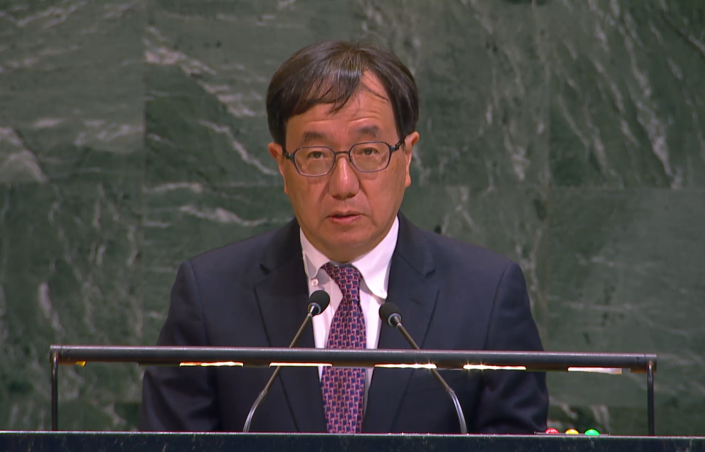
(As delivered)
Thank you, Madam President.
Achieving peace and order in the Gulf and the entire Middle East is of paramount importance not only for regional stability but for global peace and security. In this context, ensuring the safety of navigation in the Strait of Hormuz is indispensable to any meaningful normalization of the situation.
Japan has consistently supported diplomatic efforts toward early de-escalation. From this perspective, it is regrettable that the Security Council could not play a significant role in stabilizing the situation in the Strait of Hormuz at this juncture. Under these circumstances, Japan expresses its respect and support for the mediation efforts by the parties concerned, particularly the recent U.S.-Iran negotiations held in Islamabad. We hope that such diplomatic endeavors will lead to a positive impact on the normalization of transit through the Strait.
As a vital artery for global commerce, the Strait must remain open and safe for international navigation. The current situation in the Strait of Hormuz has been undermining global food and energy security. Japan underscores that ensuring free and safe passage of the Strait of Hormuz constitutes a vital foundation for global socio- economic stability, particularly for those regions such as Asia and Africa which are most directly vulnerable to disruption.
In this regard, Japan welcomes the decision made by the IMO Council on March 19th. We call for the relevant parties to take necessary immediate actions to enable the establishment of a framework such as a safe maritime corridor to facilitate the safe evacuation of merchant ships. The disruption of maritime transport not only threatens the well-being of seafarers but also hinders the integrity and viability of the international maritime system.
For our part, Japan recently hosted a summit meeting to call for a new framework called “Partnership On Wide Energy and Resource Resilience Asia (POWERR Asia)” to cooperate in emergency responses through financing procurement of crude oil, petroleum products, and maintaining supply chains in Asia, as well as in structural responses such as establishing stockpiling and release systems.
In conclusion, we call for further diplomatic efforts by Member States to restore safe international navigation through the Strait of Hormuz in accordance with international law, as reaffirmed in the Security Council resolution 2817.
I thank you.