Statement by H.E. Ambassador YAMAZAKI Kazuyuki, Permanent Representative of Japan to the United Nations, at the Special Committee on the Charter of the United Nations and on the Strengthening of the Role of the Organization
2026/2/18
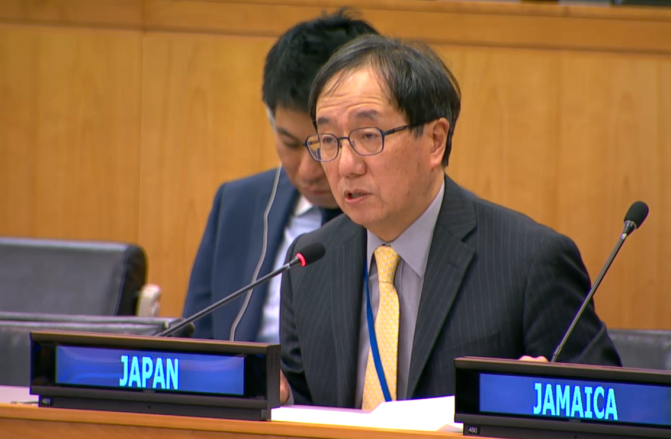
Thank you, Mr. Chair.
The Charter of the United Nations remains a cornerstone for the maintenance of international peace and security. Eighty years ago, the founders of the United Nations created this Organization with the aim of preventing the recurrence of catastrophic wars and of building an international order based on the principles and rules set out in the Charter, in pursuit of lasting peace and shared prosperity. To achieve these objectives, the principles enshrined in Article 2 of the Charter continue to be core elements in maintaining the international order based on the rule of law.
The principle that international disputes must be resolved peacefully and in strict accordance with international law should be treated with utmost importance. Therefore, we underscore the vital importance of respecting and complying with mechanisms for the peaceful settlement of disputes. The Charter designates the International Court of Justice as the principal judicial organ of the United Nations. As a steadfast supporter of the Court, Japan has been honored to contribute through the appointment of highly qualified judges and by advocating for an increased budget to ensure the Court has the resources necessary for its effective functioning, and remains committed to continuing this support.
Japan accepted the compulsory jurisdiction of the International Court of Justice under Article 36, paragraph 2, of its Statute in 1958, and has since consistently demonstrated its commitment to the peaceful resolution of disputes. We strongly urge those States that have not yet done so to make such declarations, as this action clearly demonstrates a firm dedication to the rule of law.
Mr. Chair,
The Declaration on Principles of International Law concerning Friendly Relations and Co-operation among States, commonly referred to as the Friendly Relations Declaration, is regarded as a document which supplies details of the principles of the Charter. In this regard, Japan places great importance on the Declaration as a key instrument for promoting the rule of law among nations and, in particular, for ensuring the universal application of the principles enshrined in the Charter. In this context, Japan had the honor of hosting a commemorative event during International Law Week last year to mark the fifty-fifth anniversary of the Declaration’s adoption by the UN General Assembly.
This Declaration is a historic document that elucidates the substance of the principles of international law contained in the Charter, and its norms must be revisited and reaffirmed as essential guidance as we confront the challenges of today’s world.
Japan is of the view that the Declaration continues to possess great relevance in contemporary international relations and plays a significant role in reinforcing the rule of law within the international community.
Mr. Chair,
Given that the China’s assertions as to Japan are factually incorrect and ungrounded, I hereby needs to reiterate its position.
There are countries in the international community that have been rapidly increasing their military capabilities in a non-transparent manner for many years and continuously intensifying unilateral attempts to change the status quo by force or coercion. Japan opposes such moves and distances itself from them. Japan’s consistent contributions to international peace and stability as a peace-loving nation are widely recognized. Japan’s efforts to strengthen its defense capabilities are in response to an increasingly severe security environment and are not directed against any specific country. Japan’s fundamental defense policy is the posture of passive defense strategy, and Japan will not exercise the right of self-defense in the absence of an armed attack. Therefore, China’s statement and characterization of Japan’s defense policy is erroneous. Regarding Taiwan, Japan reiterates its consistent position of expecting that the issue surrounding Taiwan will be resolved peacefully through dialogue.
Mr. Chair,
In closing, Japan reiterates its steadfast commitment to playing a meaningful role in ensuring that the vision set forth in the Charter is realized and that the rule of law is fully respected.
I thank you.