
Statement by H.E. Ambassador YAMAZAKI Kazuyuki, Permanent Representative of Japan to the United Nations, at the Security Council Open Debate “Reaffirming International Rule of Law: Pathways to Reinvigorating Peace, Justice and Multilateralism”
2026/1/26
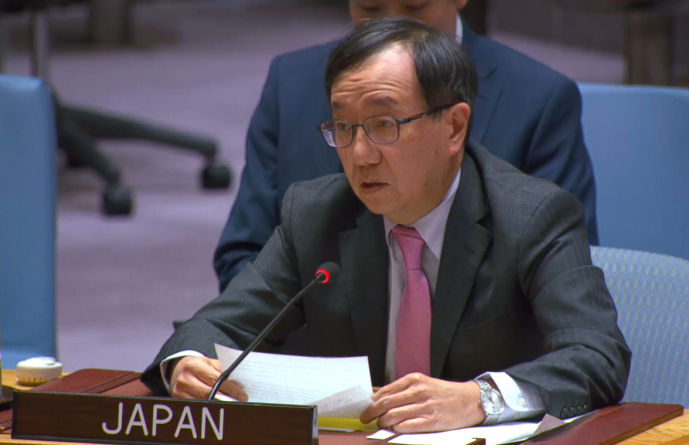
(As delivered)
Thank you, Mr. President.
At the outset, Japan appreciates Somalia's initiative to hold this open debate under the theme of Reaffirming International Rule of Law. Japan, as President of the Security Council in January 2023, also held an open debate on the rule of law among nations. What Japan wished to emphasize at that debate was that the maintenance of international peace and security, as stated in the very first article of the UN Charter, cannot be achieved unless international law is respected and implemented in good faith. Japan welcomes this open debate which shares the same concerns that we had three years ago.
The international community based on the rule of law cannot be achieved without multilateralism. Multilateralism with the UN at its core has been a critical driver of international community’s quest towards the rule of law.
However, we are faced with the reality that the UN’s vision for international peace and security based on the purposes and principles of the Charter is difficult to achieve when fundamental norms such as the prohibition of acquisition of territory by force is not observed in good faith. As stated in the “Friendly Relations Declaration”, adopted in 1970 after overcoming serious divisions among Member States through persistent dialogue, Member States must cooperate with each other to confront serious violations of the principles of the Charter.
Mr. President,
To achieve the rule of law among nations, as Article 2, paragraph 3 and Chapter VI of the Charter stipulate, international disputes must be settled by peaceful means without resorting to coercive measures. In this regard, promoting the peaceful settlement of international disputes through the appropriate use of international judicial institutions such as the ICJ and PCA is crucial. Japan emphasizes the role of such judicial institutions in reinforcing the rule of law in the international community.
As part of efforts to strengthen the role of such institutions, given that only 74 States have made a declaration under Article 36, paragraph 2 of the ICJ Statute, Japan calls for Member States who are committed to the rule of law but have not yet done so to make this declaration. Taking this step clearly testifies to their strong commitment to the rule of law.
Over the past 80 years, the UN has served as the center of multilateralism. However, as we face today's complex global challenges, confidence in the UN and multilateralism itself stand at a critical juncture.
Japan believes that the rule of law based on the UN Charter benefits all nations, as envisioned by the founders of the United Nations 80 years ago. Therefore, Japan will continue to cooperate with fellow Member States towards the realization of this farsighted vision.
Mr. President,
It is regrettable that Chinese delegation made groundless statements against Japan.
Today’s open debate is a venue for constructive discussion on the rule of law, thus the discussions should be legal, factual-based and meaningful for global peace and stability, rather than criticizing each other with baseless argument.
Since the end of World War II, Japan has consistently followed the path of a peace-loving nation and made innumerable contribution to the peace and prosperity of the international community, including the multilateral system, based on the principle of rule of law.
Japan's fundamental defense policy is the posture of passive defense strategy, which is exclusively defense-oriented, contrary to the Chinese side’s claims. Japan also defines, through domestic law, situations in which the right of collective self-defense recognized under the UN Charter is allowed to be exercised, in a restrictive manner. Japan's defense strategy is completely consistent with international law including the UN Charter.
Thus China's characterization of Japan’s defense position and policy orientation is entirely groundless. The argument contradicts fact-based discussion, which serves as a fundamental principle of the rule of law, and is unsubstantiated and irrelevant. China should engage in accurate discourse that contributes to global stability.
To conclude, Japan believes that differences of views should be addressed through dialogue, for that is at the core of the spirit of the UN Charter.
I thank you.
In response to the exercise of right of reply by the Chinese delegation at the meeting, Mr. Yasuhiro Nakai, Counsellor, delivered the following statement.
What was said by the Chinese delegation against Japan is unacceptable. Japan's position, including on our well-known path as a peace-loving nation, is already stated in our previous statement as well as in our PR’s letters to the SG dated November 24th and December 4th last year in response to the Chinese PR’s letters, thus I will not repeat it. It is unproductive to make such unsubstantiated argument in our important discussions for the better future of the United Nations. The theme of this debate is the rule of law, and I repeat our call for Member States who are committed to the rule of law but have not yet done so to make the declaration accepting the ICJ's jurisdiction. Taking this step clearly testifies to their strong commitment to the rule of law, which Japan has been doing since 1958, when Japan accepted the compulsory jurisdiction of the ICJ.
In response to the second exercise of right of reply by the Chinese delegation at the meeting, Mr. Yasuhiro Nakai, Counsellor, delivered the following statement.
What was said by the Chinese delegation against Japan is unacceptable. Japan's fundamental defense policy is the posture of passive defense strategy, which is exclusively defense-oriented and consistent with international law including the UN Charter. China's characterization of Japan’s defense position and policy orientation is entirely groundless. This open debate should be an opportunity to discuss how we can strengthen the rule of law among nations. As mentioned earlier, Japan has been calling for Member States to make the declaration accepting the ICJ's jurisdiction. Japan has been doing so since 1958 and this clearly testifies our strong commitment to the rule of law. States who claim to be committed to the rule of law should do so too.