Statement by H.E. Dr. KUNIMITSU Ayano, State Minister for Foreign Affairs of Japan, at the United Nations Security Council Open Debate, “The Safety and Protection of Waterways in the Maritime Domain”
2026/4/27
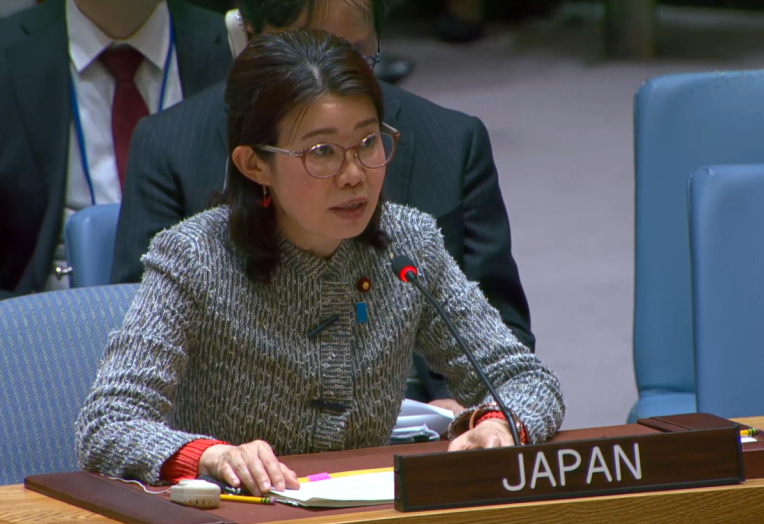
(as delivered)
Thank you, Mr. President,
I wish to express Japan’s gratitude to Bahrain for taking the initiative to hold this timely meeting. I also thank the briefers for their briefings.
The seas and the oceans connect us and allow us to live and prosper. As reflected in the 1982 United Nations Convention on the Law of the Sea, safety of passage must be upheld and we cannot overemphasize the importance of the maritime legal order now more than ever. I take this opportunity to call for full respect for the rule of law at sea as a common interest for all humanity that is essential for global peace, stability and prosperity.
Mr. President,
The situation in the Strait of Hormuz has served as a potent reminder to the international community that free, open, and stable maritime routes are vitally important for our lives and economic activities. The Strait must remain open and safe for international navigation as an international public good and as a crucial foundation for the global trade network sustaining billions of the population.
Japan supported the Security Council Resolution 2817 to underscore that safe and free navigation of merchant and commercial vessels must be respected in accordance with international law.
We also welcome the decision made by the IMO Council on March 19th in respect of the establishment of a framework such as a safe maritime corridor, proposed by Japan. We call on the relevant parties to take necessary immediate actions in line with this decision to facilitate the safe evacuation of merchant ships.
Furthermore, Japan welcomes the UN initiatives under the leadership of the Secretary-General to ensure safe navigation in the Strait of Hormuz, including the appointment of a special envoy and the establishment of a Task Force in order to meet humanitarian needs
Mr. President,
The situation in the Strait of Hormuz should not obscure what is happening in the Indo-Pacific. We remain seriously concerned about the situation in the East China Sea and the South China Sea. We reiterate our strong opposition to any unilateral attempts to change the status quo by force or coercion, including the repeated obstruction of the freedoms of navigation and overflight, which escalate tensions and undermine regional stability.
Japan has been a strong advocate of the concept of "Free and Open Indo-Pacific (FOIP)” for the past 10 years, through which we have provided capacity-building assistance for countries in need with a view to promoting the rule of law at sea.
In this regard, we have been working closely with the UN system to provide capacity-building to maritime nations. For example, the Japan Coast Guard and UNODC have cooperated since 2018 to carry out training programmes aimed at enhancing maritime law enforcement capabilities.
In closing, Japan is determined to closely work together with the UN and Member States to maintain and reinforce the free and open maritime order based on the rule of law, to ensure safety of navigation and to foster a stable and prosperous global maritime environment for generations to come.
I thank you.