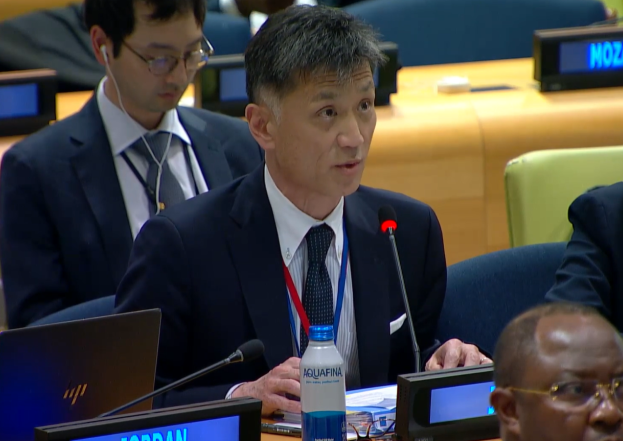
Statement delivered by H.E. Ambassador KAIFU Atsushi, Permanent Representative of Japan to the International Organizations in Vienna, at the Main Committee III (Peaceful Use of Nuclear Energy) of the 2026 NPT Review Conference
2026/5/5
Mr. Chair,
Allow me to congratulate you, Ambassador, on your assumption of the Chair of Main Committee III. You may count on my Delegation’s full support and cooperation.
Chair,
Ensuring the inalienable right to peaceful uses of nuclear energy for States Parties observing the obligations of the Treaty is one of its fundamental objectives. In an unprecedented rise of momentum for nuclear power, this Review Conference presents an important opportunity to highlight the role and significance of the Treaty.
(Role of the IAEA and Japan’s contribution)
In recognition of the IAEA’s central role in this context, Japan actively contributes to the IAEA’s Technical Cooperation Programme.
On top of the contribution to the flagship initiatives accumulating over 90 million euros since 2011 through the PUI, Japan also leverages its own resources and experience to support capacity-building for nuclear faring countries. Japan contributes to international efforts to enhance nuclear safety as well as emergency preparedness and response by sharing lessons learned from Fukushima.
(Nuclear Safety, Security and Nonproliferation)
Recognizing the need for further effort to enhance access to nuclear technology, Japan regards commitments to ensuring the highest standards of safety, security and nonproliferation as well as trust and confidence between states essential.
Japan encourages States Parties to conclude conventions on nuclear safety and security and an AP to their safeguards agreement and effectively implement them.
Also, the proper and effective implementation of export controls is vital for building trust and confidence in trade and investment, strengthens the non-proliferation regime and facilitates responsible transfer.
(Management of Civil Plutonium)
Chair,
For the sake of clarity, all nuclear material in Japan, including plutonium, is used exclusively for peaceful purposes, including as mixed oxide fuel for power generation. All such material is under exceptionally stringent IAEA safeguards including the AP, as evidenced by ongoing verification mechanisms, numbers of the areas subject to inspection and its frequency. As a result, the IAEA has drawn, and continues to draw, the broader conclusion that all nuclear material in Japan remains in peaceful activities. There is no proliferation concern regarding Japan.
Moreover, as its voluntary measures to gain confidence, Japan publishes information on its plutonium management more detailed than required in the international guidelines for civil plutonium management, which is INFCIRC 549, which is of utmost importance for transparency and confidence. I wish to remind all that one specific nuclear-weapon state has ceased to implement it in 2017. This causes a serious lack of transparency.
(ALPS treated water)
Let me provide an update and clarification regarding the discharge of ALPS treated water. For the sake of scientific accuracy, it is ALPS treated water that Japan discharges. The term “contaminated water” is inaccurate.
Since August 2023, 19 batches of water have been discharged in full compliance with relevant international standards. The safety of the discharge has been continuously confirmed through the IAEA’s ongoing reviews as
well as the multi-layered monitoring activities with the participation of analytical laboratories and international experts, including those from Japan’s neighboring countries.
Japan remains firmly committed to transparency and evidence-based explanations and reiterates the importance of a scientific approach to this matter.
Japan would like to point out that the working paper No. 64 contains unsubstantiated claims and numerous errors.
(Nuclear Safety and Security in Ukraine)
Chair,
Japan echoes the deep concerns expressed so far over nuclear safety and security in Ukraine. Japan calls for adherence to the “seven indispensable pillars” and “five concrete principles.” Japan strongly supports the IAEA in many ways, including in total 27 million euros contribution since 2022.
Chair,
In concluding, let me address the issue of withdrawal. While acknowledging Article X, withdrawal of any State Party after acquiring nuclear weapons or nuclear capabilities against its obligation not to do so would have an enormous impact on the credibility and integrity of the Treaty. Japan emphasizes that notice of withdrawal should not and cannot acquit any State Party of any illicit acquisition of nuclear capabilities.
Thank you, Chair.