Joint Press Stakeout Statement on the Situation of Women and Girls in Afghanistan
2026/3/9
(As delivered)
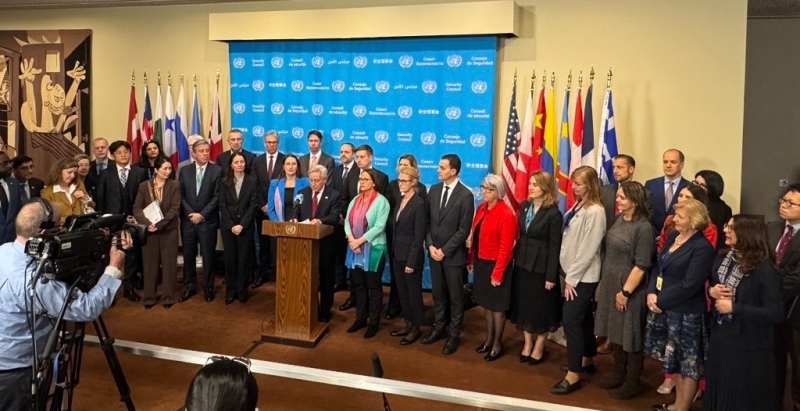
On the occasion of International Women’s Day, we, the representatives of Colombia, Denmark, France, Greece, Latvia, Liberia, the United Kingdom, signatories of the Shared Commitments on Women, Peace and Security, joined by Portugal, Spain, Estonia, Albania, Ireland, Italy, Liechtenstein, Malta, Canada, Montenegro, Croatia, Sweden, Luxembourg, Bulgaria, Sweden, Slovenia, Czechia, Bosnia and Herzegovina, New Zealand, Austria, Belgium, Australia, Finland, Afghanistan, Switzerland, Romania, Japan, Germany, the European Union, Iceland, Republic of Korea, Norway, the Kingdom of the Netherlands, Poland and my own country Panama, stand in solidarity with the women and girls of Afghanistan and strongly condemn their continued and systematic repression by the Taliban.
The human rights situation in Afghanistan has reached an increasingly critical level including the implementation of the law on the Propagation of Virtue and Prevention of Vice. We condemn the recent adoption by the Taliban, of a new nationwide penal code which institutionalizes systemic discrimination against women and girls, transforming previously imposed restrictions into binding legal provisions.
This code weakens protections against gender-based violence, including provisions allowing husbands to physically punish their wives and children, while severe acts of violence may result in minimal imprisonment sentences. This reinforces impunity and undermines access to justice and protection mechanisms, constituting clear violations of Afghanistan’s obligations under international human rights law.
We condemn the persistent erasure of women and girls from public life, including restrictions on access to education, healthcare, employment, freedom of movement and participation in society. Afghanistan remains the only country in the world where girls are banned from secondary and higher education, denying millions of girls their fundamental rights. Limitations on the training and participation of women health professionals raise serious concerns regarding access to maternal healthcare, preventable mortality and growing mental health impacts nationwide.
At the same time, civic and media space continues to shrink, with activists, journalists and civil society actors facing increasing risks of reprisals and detention. Restrictions imposed by the Taliban, on women working for the UN and humanitarian organizations, violate Security Council resolution 2681 (2023), and hinder the delivery of humanitarian aid, including medical care to women and girls.
We urge the Taliban to immediately reverse all measures restricting the rights of women and girls, restore access to education, lift employment bans, end reprisals, and respect Afghanistan’s obligations under international law, including the Convention on the Elimination of All Forms of Discrimination against Women (CEDAW). The ban preventing Afghan UN female staff from accessing their workplaces must be lifted immediately.
We welcome the recent visit to Kabul by Under-Secretary General Rosemary DiCarlo, and the recent Report of the Special Rapporteur on the situation of human rights in Afghanistan. We commend the establishment by the Human Rights Council of an independent mechanism to document violations of international human rights law and note the work of the International Criminal Court. We urge measurable progress on women’s rights through the UN-led Doha Process and the full implementation of Resolution 2593 (2021).
As today marks the opening of the 70th Commission on the Status of Women, the largest intergovernmental forum dedicated to promoting gender equality, we wish to reaffirm our strong support for the presence of the United Nations in Afghanistan and for the full renewal of UNAMA’s mandate. The rights of Afghan women and girls, their dignity and full, equal, meaningful and safe participation remain indispensable to peace, stability and prosperity in Afghanistan.