
Joint G4 Statement by Brazil, Germany, India, and Japan, delivered by H.E. Ambassador YAMAZAKI Kazuyuki, Permanent Representative of Japan to the United Nations, at the Informal Meeting of the General Assembly on the Intergovernmental Negotiations on Security Council Reform
2026/2/20
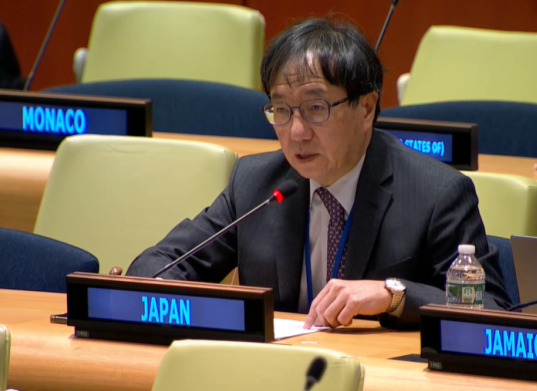
Co-Chairs,
I deliver this statement on behalf of the G4 – Brazil, Germany, India, and my own country, Japan.
While there exist various issues regarding Security Council reform, a central one has been whether to expand both the permanent and non-permanent categories. It is deeply regrettable that the IGN has failed to yield substantial outcomes on this critical aspect in the 16 years since its inception. An underlying factor for this failure is the treatment of all positions on this issue with equal importance, and as if consensus were required even to incrementally advance the process. The latter is inconsistent with Decision 62/557.
As repeatedly stated, a majority of Member States support the expansion in both the permanent and non-permanent categories. This majority voice must be duly reflected in guiding our work, in particular developing a consolidated model. Let me repeat: the majority of Member States support the expansion in both categories. Acknowledging this central principle will provide us with a more accurate picture of the current situation. It will also allow for more concrete discussions on the other issues within the five clusters, and will pave the way for a meaningful negotiating text, rather than mere compilation of the existing positions of each group or Member State.
We must also clearly recognize that, in order to truly reflect contemporary geopolitical realities and make the Council more legitimate, representative, and effective, it is essential to enhance the representation of underrepresented or unrepresented regions and groups such as Africa, Asia-Pacific, and Latin America and the Caribbean, in the permanent category.
Appropriate representation to such regions must also be secured in the non-permanent category. In addition, in line with the majority of states, the G4 stresses that due consideration should be given especially to the small and medium states including the Small Island Development States (SIDS). Representation of faith-based groups run counter to established UN practice.
Co-Chairs,
With regard to the “fixed regional seats” mentioned by the Co-Chairs at the previous IGN meeting, the G4 takes note of the intention of the Co-Chairs to reconcile differing positions within the IGN. However, this idea is not a bridge between models; rather, it is an affirmation of the models that call for expansion only in the non-permanent category. The proposed seats are essentially not any different from the current non-permanent seats, since, in the fixed regional seats, continuity of membership is not a given and hence, akin to the existing non-permanent seats. Therefore, it cannot be a substitute for permanent seats and does not constitute a sufficient solution to the structural imbalances currently existing within the Council. The G4 reiterates that this proposal disregards the majority of voices supporting the expansion in both the permanent and non-permanent categories.
It should also be noted that in terms of procedure, this idea has neither been reflected in any of the models presented thus far nor proposed officially by any member state or groups. Hence, this cannot serve as a basis for discussions or the preparation of a consolidated model.
Co-Chairs,
As the challenges facing the UN grow increasingly complex, we can no longer continue to overlook the reality that the composition of the Council, which bears primary responsibility for maintaining international peace and security, remains virtually unchanged from 80 years ago. Achieving tangible results during this 80th session is therefore critical to maintaining the confidence of Member States in the IGN process and beyond: for the UN in general. The G4 reaffirms its strong commitment to further reaching out and working in good faith with, the wider UN membership to advance meaningful reforms on the basis of a text with clearly laid out timelines and milestones.
I thank you.
In response to statements made by the Chinese and North Korean delegations at the meeting, Mr. Yasuhiro Nakai, Counsellor, delivered the following statement.
It is regrettable that the Chinese and North Korean delegations made groundless statements regarding Japan. Since the end of World War II, Japan has consistently followed the path of a peace-loving nation and made innumerable contributions to the peace and prosperity of the world including having served as a non-permanent member of the UN Security Council 12 times. Japan will continue such contributions as a responsible Member State of the United Nations.