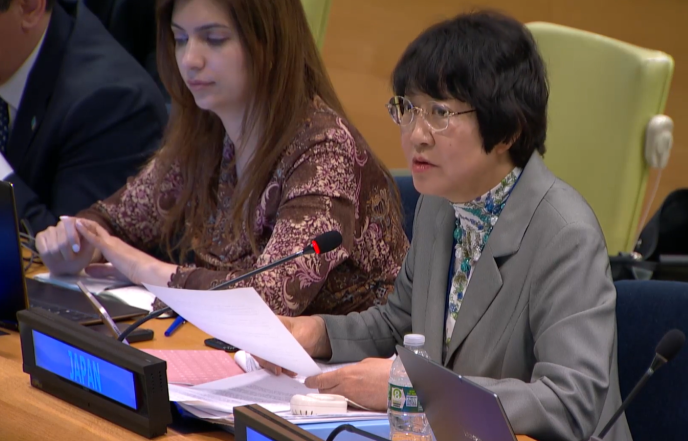
Statement delivered by H.E. Ambassador ICHIKAWA Tomiko, Permanent Representative of Japan to the Conference on Disarmament, at the Main Committee I (Nuclear Disarmament) of the 2026 NPT Review Conference
2026/5/5
Mr. Chair,
I would like to start by congratulating you, Ambassador Samuel Yao Kumah, on your assumption as the Chair of Main Committee I. I assure you and the bureau of my Delegation’s full support and cooperation.
Mr. Chair,
The NPT is the cornerstone of the global nuclear disarmament and non-proliferation architecture, and of our common efforts to achieve a world without nuclear weapons. It is crucial that this Review Conference serves as an opportunity for all of us to reaffirm this. Japan, as a staunch supporter of the NPT, will continue to advance a realistic and practical approach to nuclear disarmament. I will focus on four key actions.
First, we must extend the record of the non-use of nuclear weapons. “A nuclear war cannot be won and must never be fought”. In this context, I would like to refer to the joint statement on disarmament and non-proliferation education that I delivered on 30th April on behalf of 116 States Parties including Nepal and Papua New Guinea. Japan will continue to work tirelessly, with partner countries, to convey the realities of the use of nuclear weapons beyond borders and generations.
Second is enhancing transparency and accountability. In light of the 13 Steps adopted at the 2000 Review Conference and the 2010 Action Plan, Japan would like to emphasize the special responsibility of nuclear weapon States to report on their nuclear disarmament activities and the fulfilment of their obligations and commitments under the Treaty. Japan supports allocating dedicated time within the review cycle to discuss NPT implementation reports submitted by nuclear weapon States. I will further elaborate on this point in the discussions of Subsidiary Bodies I and III.
Third, we are seeing accelerating moves that run counter to the progress in nuclear disarmament, such as the rapid buildup of nuclear capabilities in a non-transparent manner. Faced with the increasing risk of a nuclear arms race, it is all the more important for the nuclear-weapon States to promote meaningful discussions on arms control and on measures to reduce nuclear risks.
Japan believes that efforts on disarmament and arms control involving the United States, Russia, and China are of critical importance. We welcome the United States’ intention to reestablish an arms control framework that reflects the current challenging security environment. Japan also welcomes the efforts by France, United Kingdom and the United States regarding transparency and risk reduction, and encourages all nuclear-weapon States to engage in constructive dialogues.
Fourth, it is now more imperative than ever to limit both quantitative and qualitative development of nuclear weapons. Japan believes that the immediate commencement of FMCT negotiations and the universalization and entry into force of the CTBT are the key instrument to achieve these two objectives most effectively.
Japan is determined to continue its efforts to heighten the political momentum for commencing negotiations on an FMCT. Pending the entry into force of an FMCT, Japan also calls upon all relevant states to declare or maintain moratoria on fissile material production for use in nuclear weapons or other nuclear explosive devices.
Japan urges all states to sign and ratify the CTBT, particularly the remaining States listed in Annex 2. Pending the CTBT’s entry into force, Japan also emphasizes the importance of moratoria on any nuclear weapon test explosions or any other nuclear explosions.
I would like to say a few words on Japan’s policy. Japan has consistently maintained its path as a peace-loving nation since the end of WW2, upholding freedom, democracy, and the rule of law and contributing to international peace and prosperity. This remains unchanged.
Japan, as a staunch supporter of the NPT, has been advocating for the implementation of all its provisions. This of course includes compliance with its own obligations under the NPT, and Japan continues its cooperation with the IAEA in a transparent manner.
The Government of Japan observes the Three Non-Nuclear Principles as policy guidelines. Japan has been limiting its research, development and use of nuclear energy exclusively for peaceful purposes under the Atomic Energy Basic Act.
In this regard, Japan would like to point out that the working paper No. 64 submitted by a certain country contains unsubstantiated claims and numerous errors.
Mr. Chair,
As the only country to have ever suffered atomic bombings during war, Japan stands ready to further cooperation with NPT States Parties to promote practical and concrete measures towards a world without nuclear weapons.
Thank you, Mr. Chair.